Affiliate Disclosure: This post contains affiliate links. If you purchase through them, we may earn a small commission at no extra cost to you. We only recommend products we genuinely believe can help you.
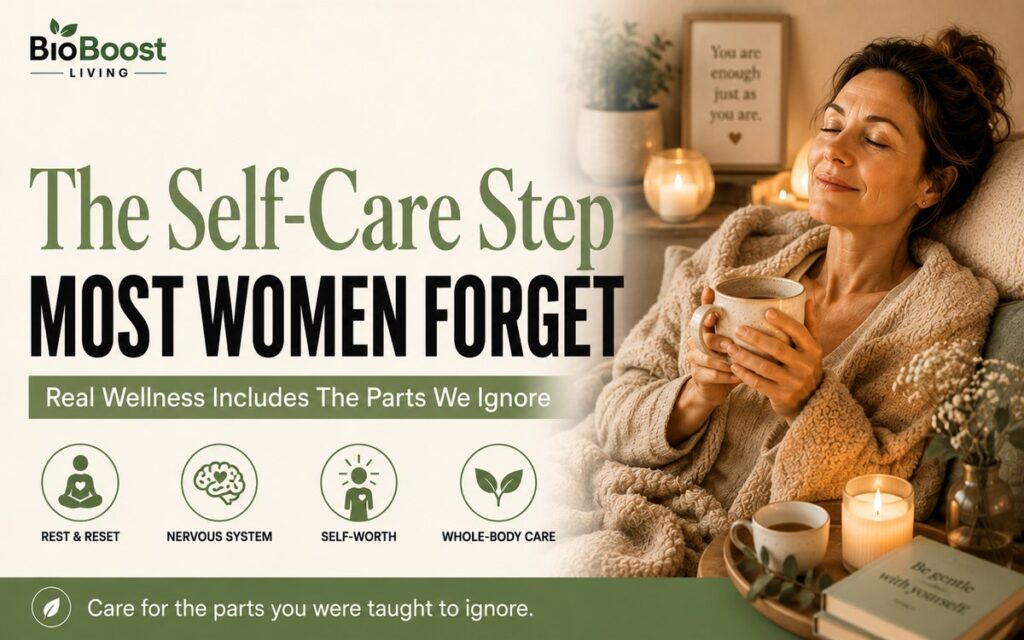
Open any self-care checklist and you will see the same things. Take a bath. Light a candle. Do a face mask. Drink your water. Journal your feelings. All of it is genuinely nice, and none of it is wrong. But there is a whole area of a woman’s wellbeing that almost never makes these lists, and it happens to be one of the most important. We are talking about your intimate health and your desire, the parts of you that quietly fade when you are running on empty.
Most women were raised to treat that part of themselves as either private to the point of secrecy, or as something that exists mainly for a partner rather than for their own wellbeing. So when it starts to slip, they say nothing, they do nothing, and they certainly do not think of it as a self-care issue. That silence is the gap this article is here to fill.
Real Self-Care Includes the Uncomfortable Parts
Self-care got flattened into a marketing idea somewhere along the way. It became products and bubble baths, things you can buy and post about. But the original idea was bigger and less pretty. It meant tending to your whole self, including the parts that are harder to talk about.
Your energy, your hormones, your sleep, your mood, and yes, your desire, are all part of your wellbeing. When one of them is struggling, it usually means the others are too, because they are all connected. A woman who has lost interest in intimacy is very often the same woman who is exhausted, stretched thin, and running on stress. Treating the desire as a standalone problem misses the point. Treating it as a signal from a depleted system is where the real self-care begins.
Why Desire Fades When You Stop Tending to Yourself
Think about the version of you that pours everything into work, children, partners, aging parents, and the endless small tasks that keep a household moving. By the time everyone else is handled, there is nothing left for you. Not for rest, not for pleasure, not for the quiet spaciousness that desire needs to exist.
Desire is not something you can force on demand, especially not when your nervous system is stuck in a state of constant doing. It needs safety, rest, and enough resources in the tank. When you never refill that tank, your body reads the situation clearly and puts desire on hold. It is not a malfunction. It is your body protecting you by shutting down what it sees as optional.
This is exactly why the missing self-care step is not really about the bedroom at all. It is about giving yourself enough to have something left over. We explored this same idea from the energy angle in why being always exhausted and not in the mood are more connected than you think, and the two articles are really two views of the same truth.
An Evening Reset That Actually Restores You
If you want a self-care routine that reaches the parts other routines skip, build it around calming your nervous system rather than just pampering your skin. Both are fine, but only one moves the needle on desire.
Start by giving yourself a real transition out of the day. That might be a warm shower, a few slow breaths, ten minutes with the phone in another room. The goal is to signal to your body that the alert, doing part of the day is over. Gentle stretching or a short walk helps your body lower its stress hormones. A magnesium-rich snack or a cup of herbal tea supports the shift toward rest.
Then, and this is the part women skip, give yourself permission to feel good in your body for no reason and for no one but yourself. That might be as simple as noticing what feels nice, moving in a way that feels good, or spending a few minutes without a single demand on you. Reconnecting with your body outside of chores and caretaking is quietly powerful, and it is where desire slowly starts to breathe again.
Feed the System Behind Your Desire
Self-care also happens on your plate. The same foods that steady your hormones and energy support your desire, because they are all part of the same system. Protein and healthy fats give your body the raw materials to make hormones. Fiber and colorful produce support the gut and liver that regulate them. Steady blood sugar keeps your stress hormones from hijacking everything.
If you want a practical starting point, our guide to foods that naturally balance women’s hormones after 40 lays it out simply. Think of eating this way not as a diet but as a daily act of taking care of yourself.
When Self-Care Needs a Little Extra Support
Sometimes you do all the right things and your body still needs help catching up. Long stretches of stress, poor sleep, and hormonal change can leave desire lagging even after you have started taking better care of yourself. There is no shame in that, and there is no prize for white-knuckling it alone.
A natural supplement designed to support blood flow, arousal, and hormone balance can be part of a thoughtful self-care approach, the same way you might use magnesium for sleep or omega-3s for your mood. We took an honest look at one in our HerSolution review, including what it does, what it does not, and who it tends to help. If you want the direct picture of what is happening with desire and why, low libido in women: natural remedies that actually help is a good place to go next.
Give Yourself Permission
The reason this self-care step gets forgotten is not that women do not care about it. It is that they were taught not to prioritize it, not to talk about it, and to feel a little embarrassed for wanting it. Letting go of that is the real work.
Your desire and your intimate wellbeing are yours. They are not a luxury and they are not only for someone else. Tending to them is as legitimate a part of self-care as anything on the usual checklist, arguably more so, because it touches your energy, your confidence, and your sense of being fully alive. So the next time you plan a little care for yourself, remember the step most women forget, and give that part of you some attention too.
Disclaimer: This content is for informational purposes only and is not medical advice. These statements have not been evaluated by the Food and Drug Administration. This product is not intended to diagnose, treat, cure, or prevent any disease. Consult your healthcare provider before starting any new supplement, particularly if you are pregnant, nursing, or managing a medical condition.
Written by Julia Wayne