Affiliate Disclosure: This post contains affiliate links. If a reader purchases through them, BioBoost Living may earn a small commission at no extra cost. We only recommend products we believe can genuinely help.
Lorna stood at the beauty counter for twenty minutes on a Saturday afternoon.
Fourteen jars. Fourteen promises. Gold flakes, snail mucin, “stem cells,” a serum that cost more than her weekly groceries.
She was 52, and she only wanted a plain list of the anti-aging ingredients that actually work.
The young woman at the counter suggested all of them.
At home, her daughter rolled her eyes and said skincare was “just marketing for anxious people.”
Her husband said she looked fine. He meant it kindly. It did not help.
That evening Lorna lined up the half-used bottles on her bathroom shelf and counted them.
Eleven.
Somewhere in that pile, she suspected, there were two or three things doing real work.
She just had no idea which ones.
(Lorna is a composite of experiences many women describe, not a real customer.)
This guide sorts the most common anti-aging ingredients by the strength of the evidence behind them, then turns that ranking into a simple morning and evening routine. I have kept it practical, and where the research is thin, I say so.
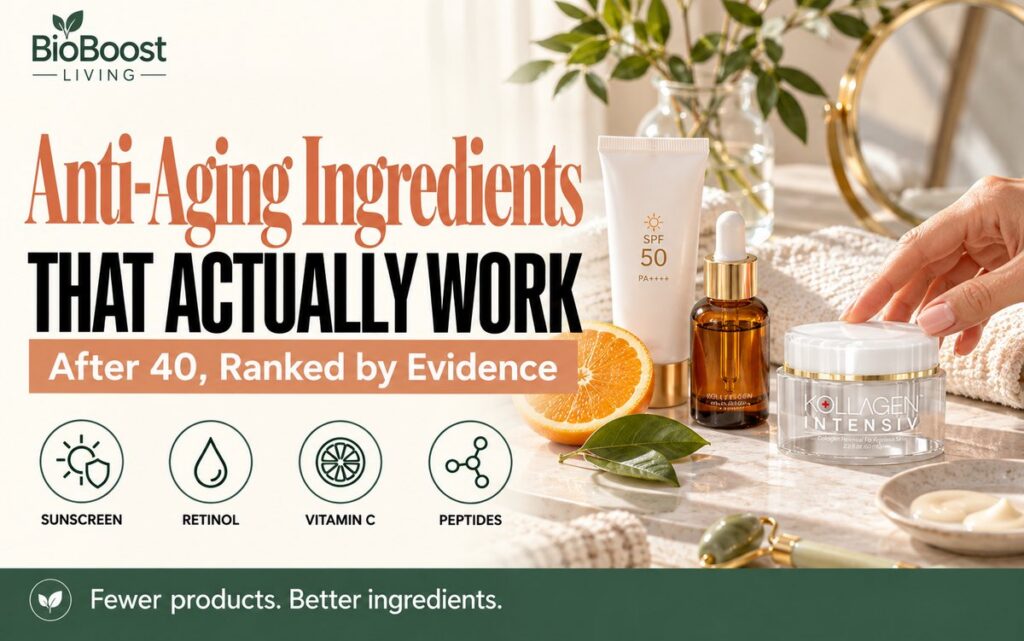
The short answer: The anti-aging ingredients that actually work, in order of evidence, are daily broad-spectrum sunscreen, prescription retinoids such as tretinoin, over-the-counter retinol and vitamin C. Peptides, niacinamide and gentle acids have smaller but real supporting evidence. Hyaluronic acid and glycerin hydrate and plump temporarily, and most exotic extracts have little research behind them.
Why so much anti-aging advice leaves women confused
Lorna’s daughter has a point. A lot of skincare marketing leans on vague words like “renewing” and “cellular,” and on percentages that are hard to interpret. Her husband has a point too: no cream changes a face dramatically.
But “it is all marketing” is too cynical. A handful of ingredients have decades of research behind them, including controlled trials. The confusion comes from three places:
- Everything is presented as equal. A cream with retinol and a cream with caviar extract sit on the same shelf at the same price.
- Short-term and long-term effects get mixed up. Hydrators make skin look better within an hour. Retinoids take months. Shoppers often judge the wrong one too early.
- The basics are boring. Sunscreen does not sell a fantasy, so it gets less attention than it deserves.
What changes in skin after 40
Collagen is the protein that gives skin its firmness. A commonly cited estimate is that the body produces about 1% less collagen each year from the mid-20s onward. In the first five years after menopause, as estrogen falls, the loss appears to speed up, with figures of around 30% often quoted. Those numbers are estimates from limited studies, but the direction is well established.
At the same time, skin cell turnover slows, the skin barrier holds less water, and years of sun exposure show up as fine lines, uneven tone and rougher texture. Sun damage, known as photoaging, is thought to account for a large share of visible facial aging, which is why sunscreen keeps appearing at the top of every serious list.
Energy, sleep and stress show on the face too. I wrote about the bigger picture in why women feel so tired after 35.
Anti-aging ingredients that actually work, ranked by evidence
| Ingredient | What it does | Evidence | Typical timeline |
|---|---|---|---|
| Broad-spectrum sunscreen (SPF 30+) | Prevents further collagen breakdown from UV | Strongest; long-term trials | Ongoing protection |
| Tretinoin (prescription retinoid) | Boosts collagen, smooths fine lines and texture | Strong; many controlled trials | 3 to 6 months |
| Retinol (over the counter) | A weaker, slower version of the same effect | Moderate | 3 to 6 months |
| Vitamin C (L-ascorbic acid) | Antioxidant protection, brighter tone, supports collagen | Good | 1 to 3 months |
| Niacinamide | Supports the barrier, evens tone | Moderate | 1 to 3 months |
| Alpha hydroxy acids (glycolic, lactic) | Exfoliate for smoother texture | Moderate | 4 to 8 weeks |
| Peptides (such as Matrixyl) | Signal skin to support collagen | Small, mostly industry-funded studies | 2 to 3 months |
| Argireline (acetyl hexapeptide-3) | Softens expression lines slightly | Modest | 4 to 8 weeks |
| Hyaluronic acid, glycerin | Hydrate and plump | Well established, but temporary | Hours |
Sunscreen: the unglamorous winner
Daily broad-spectrum sunscreen protects existing collagen from UV damage, and long-term research suggests regular users show less visible skin aging over the years. It works best applied generously every morning, including cloudy days, and reapplied when outdoors for long stretches. Most people use far less than the amount tested on the label; a commonly suggested guide is about a quarter of a teaspoon for the face alone. A formula that feels pleasant enough to wear daily matters more than chasing the highest SPF number.
Retinoids: the best-studied active
Tretinoin, available on prescription, is the most researched topical anti-aging ingredient. Retinol, sold over the counter, converts into the active form in the skin, which makes it gentler but slower and weaker. Both can cause dryness, peeling and redness at first, so starting two or three nights a week is wise. Retinoids are generally avoided during pregnancy.
Retinaldehyde (often labelled retinal) sits between the two: it is one conversion step closer to the active form than retinol, so it tends to work a little faster, with irritation somewhere in the middle. For women who have used retinol for a year without problems, retinal or a conversation with a doctor about tretinoin is the natural next step.
Vitamin C: the daytime partner
L-ascorbic acid has the strongest research among vitamin C forms, but it can sting and is unstable once opened. Gentler derivatives such as magnesium ascorbyl phosphate are kinder to sensitive skin, although they have been studied less. Vitamin C pairs well with sunscreen in the morning.
Niacinamide and gentle acids: useful supporting players
Niacinamide, a form of vitamin B3, is well tolerated by most skin types and has reasonable evidence for supporting the skin barrier and evening out redness and blotchiness. Alpha hydroxy acids such as glycolic and lactic acid loosen dead surface cells, which makes texture smoother and helps skin reflect light. Polyhydroxy acids such as gluconolactone do something similar more gently. Acids work best a few times a week rather than every night, especially alongside a retinoid.
How to read a label without a chemistry degree
Ingredients are listed roughly in order of concentration, down to about 1%, after which the order can be loose. An ingredient that appears near the very end of a long list is usually present in a small amount. Brands rarely publish exact percentages, so I look for three things: whether the active is there at all, whether the packaging protects it (airless pumps or opaque tubes for retinol and vitamin C), and whether the claims are attributed to a named study rather than “clinically proven” with no details.
Retinol vs peptides: which matters more after 40?
This is one of the most common questions, and the answer is fairly clear: retinol has more evidence. Its effects on fine lines and texture have been shown in many independent studies.
Peptides are short chains of amino acids that appear to act as messengers, nudging skin to produce more collagen. Matrixyl 3000 (palmitoyl oligopeptide with palmitoyl tetrapeptide-3) is the best known. The studies behind peptides are mostly small and often funded by the companies that supply them, so I treat them as promising rather than proven.
The practical advantage of peptides is that they are gentle. Women who cannot tolerate retinol often turn to peptide products instead, and pregnant women sometimes do too, ideally after checking with their doctor. And they combine well: many modern creams pair a modest dose of retinol with peptides and hydrators. That means fewer bottles, although no single cream will match prescription tretinoin.
A simple morning and evening routine
Lorna’s eleven bottles could be reduced to about four products. A sensible routine for most women over 40 looks like this.
Morning
- Gentle cleanse, or just water for dry skin
- Vitamin C serum, optional
- Moisturiser
- Broad-spectrum sunscreen, SPF 30 or higher, every day
Evening
- Cleanse to remove sunscreen and makeup
- A retinoid, starting two or three nights a week and building up slowly
- Moisturiser, ideally one with hydrators and barrier support
Women who prefer fewer steps sometimes choose a single cream that combines retinol and peptides for both morning and night. Kollagen Intensiv is one example: it contains retinol, Matrixyl 3000, Argireline, vitamin C derivatives and hyaluronic acid. I looked at its formula and its much-quoted 354% claim in detail in my Kollagen Intensiv review. Any retinol cream used in the morning still needs sunscreen on top.
Routines last when they feel like care rather than a chore, a theme I explored in the self-care step most women forget.
What to skip, or at least stop overpaying for
- Collagen in creams. Whole collagen molecules are far too large to pass into the skin. They moisturise the surface, which is pleasant, but they do not top up collagen. I explain the difference in collagen cream vs collagen supplements.
- Plant “stem cells,” gold, caviar and pearl. Lovely on a label, with very little human research.
- “Botox in a jar” claims. Topical peptides like Argireline have modest effects. Nothing applied to the skin works like an injection.
- Five actives at once. Stacking retinol, strong acids and vitamin C every night is a common route to irritation.
- Impossible percentages. A wrinkle cannot shrink by more than 100%. Figures above that usually compare an ingredient with a placebo cream.
Safety notes worth taking seriously
Retinoids and strong acids can cause irritation, especially in the first month. A patch test on the inner forearm for a few days is a sensible first step with any new active. Women with rosacea, eczema or very sensitive skin usually do better asking a dermatologist before starting retinoids.
Retinoids, including retinol, are generally avoided during pregnancy and while trying to conceive. Exfoliating acids and retinoids both increase sun sensitivity, which makes daily sunscreen even more important.
Realistic expectations: what changes, and when
- Within hours: Hydrators and silicones make skin look smoother. This fades by the next day.
- 4 to 8 weeks: Acids and vitamin C can brighten and smooth the surface.
- 3 to 6 months: Retinoids gradually soften fine lines and improve texture. Prescription tretinoin shows the clearest changes.
- Years: Sunscreen’s benefit is mostly preventive, which makes it easy to underrate.
Habits matter as much as any bottle. Smoking speeds up collagen breakdown, and diets high in sugar are linked to glycation, a process in which sugar molecules stiffen collagen fibres. Poor sleep shows up quickly as dullness and puffiness.
No topical ingredient lifts sagging skin or restores lost volume. Those changes need in-office treatments, and even those have limits. Diet plays a supporting role too; protein and vitamin C intake both feed collagen production, as I covered in foods that support women’s hormones after 40.
Where a combined cream fits
For women who want one product that brings together several of the ingredients in this guide, a peptide and retinol cream is a reasonable middle ground between a basic moisturiser and prescription tretinoin. Kollagen Intensiv is one such option, with a 67-day money-back guarantee according to the brand. The full ingredient list and pricing are on the official Kollagen Intensiv website.
See the Kollagen Intensiv Ingredient List
Frequently Asked Questions
What is the single most important anti-aging product?
Daily broad-spectrum sunscreen. It protects collagen from UV damage and has the strongest long-term evidence of any skincare product.
Is retinol or tretinoin better after 40?
Tretinoin is stronger and better studied, but it requires a prescription and can be more irritating. Retinol is a gentler starting point.
Do peptides work as well as retinol?
The evidence for peptides is smaller and mostly industry funded. They are gentle and combine well with retinol, but retinol has stronger research.
How many anti-aging products does a routine need?
Most women do well with four: a cleanser, a moisturiser, sunscreen in the morning and a retinoid at night. Vitamin C is a useful optional fifth.
Can retinol and vitamin C be used together?
Many women use vitamin C in the morning and retinol at night, which keeps irritation lower and gives each ingredient its best time slot.
Disclaimer: This content is for informational purposes only and is not medical advice. Cosmetic results vary from person to person. A patch test is recommended before using any new skincare product, and anyone with a skin condition should consult a dermatologist. Anyone who is pregnant, nursing, taking medication or managing a medical condition should speak with a healthcare provider before using a new skincare product or supplement.
Written by Julia Wayne