Affiliate Disclosure: This post contains affiliate links. If a reader purchases through them, BioBoost Living may earn a small commission at no extra cost. We only recommend products we believe can genuinely help.
Theresa, 49, stood in aisle seven of the pharmacy for eleven minutes.
In front of her: a wall of tubes. Warming. Tingling. Sensitive. Natural. “Intensifying.”
Behind her, two teenage stock boys were stacking shampoo and very obviously trying not to look.
She picked one up. Put it down. Picked up another.
Her sister had told her to “just grab whatever, they’re all the same.” Her husband just shrugged.
Something had changed. Sex was not only drier. It felt quieter, as if the volume had been turned down.
She left with nothing. In the car, she typed “arousal gel vs lubricant” into her phone.
The answer turned out to be more interesting than either of them thought.
(Theresa is a composite of experiences many women describe, not a real customer.)
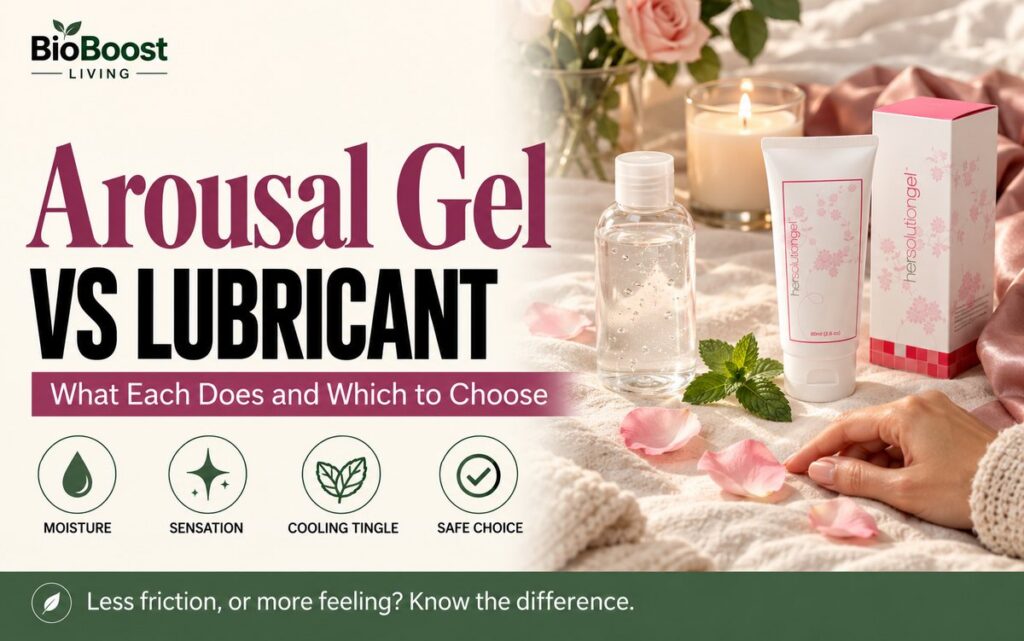
The arousal gel vs lubricant question comes up constantly, and the packaging makes it worse. Here is what each one does, how arousal gels claim to work, how they compare in a simple table, and how to try one without regret.
The short answer: A lubricant reduces friction and adds slip. That is all it is designed to do. An arousal gel usually adds slip too, but it also contains ingredients meant to change sensation, such as menthol (cooling and tingly), warming agents or L-arginine (linked to blood flow). Lubricants suit dryness. Arousal gels suit women who also feel that sensation or arousal has faded, though evidence for their active ingredients is limited and they can irritate sensitive skin.
Why “They’re All the Same” Is the Wrong Advice
Theresa’s sister was half right. Many products on that shelf overlap. But treating them as interchangeable causes three common problems.
The first is irritation. A woman with thin, sensitive tissue (very common after menopause) who grabs a tingling gel thinking it is a basic lube may get stinging instead of comfort.
The second is condom failure. Some arousal gels contain plant butters or oils, and oils can weaken latex condoms. A plain water-based lubricant does not carry that risk.
The third is disappointment. A woman whose real issue is muted sensation may buy lubricant after lubricant and wonder why nothing feels different. Slip was never the whole problem.
Knowing which category fits the problem saves money, discomfort and a lot of time standing in aisle seven.
What a Lubricant Actually Does
A lubricant has one job: reduce friction. It does not change hormones, blood flow or sensation directly. Indirectly, of course, reducing discomfort can make sex far more enjoyable, and that matters a great deal.
The three main types of lubricant
- Water-based: the most versatile. Safe with all condoms and toys, easy to wash off, but can dry out and need reapplying.
- Silicone-based: lasts much longer and stays slippery in water. Safe with latex condoms, though not always with silicone toys.
- Oil-based: rich and cushioning, including natural options like coconut oil. Not compatible with latex condoms.
There is also a fourth product often confused with lubricant: the vaginal moisturizer. Moisturizers are used every few days, regardless of sex, to help the tissue hold water over time. They are the better fit for daily dryness. I cover moisturizers in detail in my guide to vaginal dryness during sex.
How Arousal Gels Claim to Work
Arousal gels are a newer, more marketing-heavy category. Most combine a lubricating or moisturizing base with one or more “active” ingredients that aim to change how the genital area feels.
Menthol and cooling agents
Menthol activates cold-sensing nerve receptors in the skin. The result is a cooling, tingling sensation within minutes. That sensation is real and many women enjoy it. It draws attention to the area, which can help arousal build. It is a sensory effect, not a change in tissue or hormones.
Warming agents
Warming products often rely on glycols or glycerin, which can create a feeling of warmth when they meet moisture or are rubbed in. Some products add plant extracts as well. Warmth can feel pleasant, but these same ingredients are among the more common causes of stinging on sensitive skin.
L-arginine
L-arginine is an amino acid the body uses to make nitric oxide, a molecule that helps relax blood vessels. The theory is that more blood flow means more sensitivity and natural lubrication. It is a reasonable idea. The evidence in women is limited, mostly small studies of oral combination products, and research on L-arginine applied to the skin is thinner still.
Moisturizing ingredients
Many arousal gels also contain aloe, squalane, plant butters or oils. These provide the slip and comfort, and they are often the part doing the most reliable work.
Arousal Gel vs Lubricant: A Side-by-Side Comparison
| Product | Main job | Best for | Condom note |
|---|---|---|---|
| Water-based lubricant | Reduces friction | Occasional dryness, all couples | Safe with all condom types |
| Silicone lubricant | Long-lasting slip | Longer sessions, sensitive skin | Safe with latex; check with silicone toys |
| Oil-based lubricant | Rich, cushioning slip | Women not relying on latex condoms | Weakens latex |
| Vaginal moisturizer | Ongoing tissue hydration | Daily dryness, menopause | Used separately from sex |
| Arousal gel | Slip plus sensation (tingle, warmth) | Muted sensation, slow arousal | Varies; check with the maker if it contains oils or butters |
Does Arousal Gel Work? What the Evidence Shows
This depends on what “work” means.
If it means “creates a noticeable sensation,” most menthol or warming gels do exactly that. The tingle or warmth is felt by most women within minutes.
If it means “makes arousal easier,” it may, for some women. Sensation focuses attention, and attention is a big part of female arousal. Many women find their minds wander during sex, especially when tired or stressed. A strong physical cue can bring them back into the moment.
If it means “increases blood flow and sensitivity over time,” the evidence is not there. No large, independent trials show that topical L-arginine or warming agents produce lasting physical changes.
My view: arousal gels are best seen as a sensory tool, not a treatment. That is still useful, especially for women whose problem is that sex has started to feel flat. For those dealing with more stubborn changes in climax, my piece on why it can be hard to reach orgasm after 40 looks at the wider causes. And for desire itself, my look at natural libido boosters and what works sorts real options from hype.
Two Common Arousal Gels: HerSolution Gel and Vigorelle
Two names come up often, both from the same company, Leading Edge Health.
HerSolution Gel is described by the manufacturer as an “instant arousal gel.” Its published ingredients include aloe, olive squalane, shea and cocoa butter, L-arginine and menthol. The brand says it eases dryness, speeds arousal and increases sensation. Because it contains butters, latex compatibility is worth confirming with the company. I went through every ingredient in my HerSolution Gel review.
Vigorelle is an arousal cream from the same maker, which the brand says uses a blend of botanical ingredients. It is often compared with HerSolution Gel, and I cover it separately in my Vigorelle review.
The Best Arousal Gel for Women: What I Look For
There is no single best arousal gel for every woman. Skin, hormones and preferences vary too much. But here is the checklist I use when evaluating one:
- A short, fully published ingredient list. Hidden “proprietary blends” are a warning sign.
- No added fragrance. Perfume has no business near delicate tissue.
- Clear condom guidance. If a gel contains oils or butters, the brand should say whether it is latex-safe.
- Modest claims. Products that promise to “restore,” “cure” or “rejuvenate” are overselling.
- A fair refund policy. Since reactions vary so much, a guarantee lowers the risk of trying.
- A moderate sensation. A product that is mostly moisturizer with a gentle tingle tends to suit more women than one that burns.
Safety: pH, Osmolality, Irritation and Condoms
pH
A healthy vagina is mildly acidic, roughly pH 3.8 to 4.5 before menopause, and somewhat higher after. Products far outside that range may make some women more prone to irritation or infections. Many brands do not publish pH, which is a gap.
Osmolality
The World Health Organization and UNFPA have advised that intimate lubricants should not be too concentrated (high osmolality). Very concentrated formulas can draw water out of delicate tissue, which may leave it more irritated. Simpler formulas tend to be gentler.
Irritation
Menthol, glycols, glycerin and warming agents are the usual suspects. Women with thin tissue after menopause, active infections, eczema, lichen sclerosus or recent pelvic surgery are more likely to react.
Condoms
Water-based and silicone lubricants are safe with latex. Oils and butters weaken latex. Arousal gels vary, so this is worth checking before relying on one for protection.
How to Try an Arousal Gel Sensibly
- A patch test comes first: a small dab on the inner arm, left for 24 hours.
- A pea-sized amount is plenty the first time. More is not better with menthol.
- Many women find a solo trial less pressured than a first try with a partner.
- If burning lasts more than a few minutes, rinsing with plain water usually helps.
- A plain lubricant on hand is useful, since some gels add sensation but not quite enough slip.
- Persistent pain, bleeding or unusual discharge is a reason to stop and see a doctor.
Realistic Expectations
Lubricants help immediately with comfort and nothing more, which is often plenty.
Arousal gels create a sensation within minutes. Whether that translates into easier arousal varies widely. Some women love it from the first try. Some find the tingle distracting. Most know within two or three uses.
Neither changes hormones or rebuilds thin tissue. For dryness that shows up during daily life, a moisturizer or a conversation with a doctor about vaginal estrogen is the better route.
Who Might Want to Try an Arousal Gel
An arousal gel might suit a woman who is comfortable with basic lubrication but feels that sensation has faded, who has no skin sensitivity or infection, and who is curious rather than desperate. For women in that spot, HerSolution Gel is one well-known option with a 67-day money-back guarantee, according to the company. The full ingredient list and terms are on the official HerSolution Gel site.
See HerSolution Gel’s Ingredients and Guarantee
Frequently Asked Questions
Can an arousal gel replace a lubricant?
Sometimes. Many arousal gels provide slip as well as sensation. But some do not provide enough for longer sessions, so many women use both.
Is arousal gel safe after menopause?
Many postmenopausal women use them without problems, but thinner tissue can be more sensitive to menthol and warming agents. A patch test and a small first amount make sense.
Do arousal gels work for everyone?
No. Sensation varies a lot between women. Some feel a pleasant tingle, some feel little, and some find it irritating.
Can arousal gels be used with condoms?
It depends on the formula. Gels containing oils or butters may weaken latex. It is worth checking with the maker.
Are arousal gels the same as libido supplements?
No. Gels work on the skin in the moment. Libido supplements are taken by mouth over weeks and aim at desire, with mixed evidence.
Disclaimer: This content is for informational purposes only and is not medical advice. These statements have not been evaluated by the Food and Drug Administration. This product is not intended to diagnose, treat, cure, or prevent any disease. Anyone who is pregnant, nursing, taking medication or managing a medical condition should speak with a healthcare provider before using a new supplement or intimate product.
Written by Julia Wayne