Affiliate Disclosure: This post contains affiliate links. If a reader purchases through them, BioBoost Living may earn a small commission at no extra cost. We only recommend products we believe can genuinely help.
Marisol, 51, kept a folded hand towel on her nightstand.
It was for 3:10 a.m., when the heat rose up her neck like an oven door opening.
She had stopped reaching for her husband months ago. Desire had gone quiet, and sex had started to sting.
At her checkup, she mentioned both. The doctor kept typing and said, “That’s just the age.”
Her sister laughed: “Wine helps.”
One night, scrolling in the dark, she opened her fourth Provestra review. A pink box promised to balance three hormones in seven days.
She hovered over the order button for a long time.
She wanted to know one thing first: was any of it real?
(Marisol is a composite of experiences many women describe, not a real customer.)
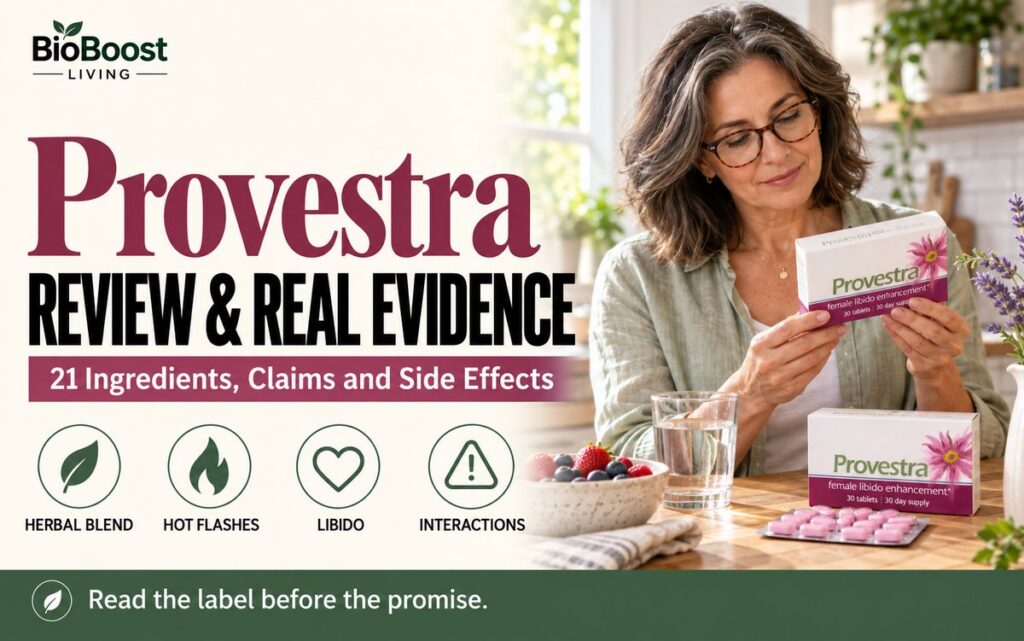
This Provestra review is written for women standing exactly where Marisol stood, with a cart open and a lot of questions. I went through the label, the brand’s claims and the research behind each ingredient, so the decision can rest on facts rather than on a sales page.
The short answer: Provestra is a daily multi-herb and vitamin tablet from Leading Edge Health, marketed for libido, lubrication and menopause symptoms. Several of its ingredients have some research behind them, but the formula itself has not been tested in published clinical trials, the doses are not disclosed, and a few ingredients carry real interaction risks. It may suit a healthy woman who wants to try a gentle herbal option with a 67-day guarantee, after checking with a doctor.
Why the usual advice leaves women stuck
Women in their late 40s and 50s tend to hear two kinds of advice about low desire and hot flashes, and neither one helps much.
The first is the shrug: it is normal, it will pass, have a glass of wine. Menopause is normal, but sleepless nights, painful sex and a libido that has gone missing are real problems with real causes, and many of them respond to treatment.
The second is the sales page, full of words like “balance” and “natural” and numbers that sound scientific. Women who have been brushed off by a doctor are primed to believe it.
So the useful questions are practical. What is in it? Do those ingredients work at realistic doses? Is it safe alongside common medicines? And do the brand’s biggest promises hold up?
What Provestra is and who makes it
Provestra is an oral supplement taken once a day. It is sold by Leading Edge Health, the same company behind HerSolution, HerSolution Gel and Vigorelle. According to the manufacturer, it supports libido, natural lubrication and orgasm, and it also eases common menopause complaints: hot flashes, night sweats, poor sleep, mood swings, memory lapses and irregular cycles.
That is a wide list for one tablet, and the first hint that this is a broad blend rather than a targeted treatment.
At the time of writing, one box costs $59 (listed MSRP $69), and larger bundles bring the per-box price down. The brand offers a 67-day money-back guarantee. Shipping is not refunded, and buyers need to return the containers, even empty ones, to claim it.
Provestra ingredients, one by one
The label lists about 21 ingredients but not the amount of each. That matters, because studies on these herbs used specific doses, and a sprinkle in a crowded blend may behave nothing like the amount tested.
| Ingredient | Marketed for | What the evidence shows |
|---|---|---|
| L-Arginine | Blood flow, arousal | Small studies of arginine combination products reported some improvement in female sexual satisfaction; no strong trials of arginine alone in women |
| Ginseng | Energy, arousal | Some small trials of Korean red ginseng suggest modest benefit for arousal in menopausal women; quality varies |
| Ginkgo Biloba | Circulation, desire | Mixed results; may slightly help women whose low desire is linked to antidepressants, but trials disagree |
| Damiana Leaf | Libido | Traditional use; human evidence mostly comes from multi-ingredient products |
| Black Cohosh | Hot flashes | A 2012 Cochrane review found insufficient evidence that it beats placebo; rare reports of liver injury |
| Red Raspberry | Female reproductive tonic | Traditional use, little modern clinical evidence |
| Licorice Root | Hormone support | Very limited evidence for menopause; can raise blood pressure and lower potassium at higher intakes |
| Kudzu | Phytoestrogen support | Contains isoflavones; human results for hot flashes are inconsistent |
| Ginger Root | Digestion, circulation | Good evidence for nausea; no clear menopause or libido evidence |
| Valerian Root | Sleep | Mixed sleep evidence; may cause drowsiness |
| Indole-3-Carbinol | Estrogen metabolism | Mostly lab and early research; can interact with some medicines |
| Theobromine | Mood, energy | Mild stimulant from cocoa; no specific libido evidence |
| Vitamins A, C, E, B-complex, folic acid, biotin | General support | Useful for women who are low in them; unlikely to change libido on their own |
| Calcium, iron, zinc | General support | Iron is rarely needed after menopause and is a poisoning risk for children |
The pattern is clear once it is laid out. A handful of ingredients have small, encouraging studies behind them, mainly ginseng and arginine for arousal. The best-known menopause herb in the blend, black cohosh, has disappointing evidence for hot flashes. Many of the rest are traditional or general-wellness ingredients. And because amounts are hidden, there is no way to know whether any of them is present at a studied dose.
The “balances 3 key hormones” claim, examined
The brand says Provestra balances estrogen, progesterone and testosterone and calls its formula “18 hormone balancing ingredients.” This is the claim most worth slowing down on.
There are three problems with it.
No published hormone testing
I could not find any published study in which women took Provestra and had their estrogen, progesterone or testosterone measured before and after. Without that, “balances hormones” is a marketing phrase, not a finding.
Most ingredients do not act on hormones
Vitamins, minerals, ginger, valerian and theobromine are not hormone treatments. Kudzu and licorice contain plant compounds that interact weakly with estrogen receptors, and indole-3-carbinol affects how the body breaks down estrogen. None of that adds up to restoring the hormone levels that drop at menopause.
“Balance” is undefined
During perimenopause, hormone levels swing from week to week; after menopause, estrogen and progesterone settle low. There is no single “balanced” number for a supplement to aim at, which makes the phrase easy to use and hard to test. Readers interested in the bigger hormone picture may find more practical value in foods that support women’s hormones after 40 and in sleep and stress basics.
What the “98% would buy again” survey really means
Provestra’s sales page says 98% of customers would buy it again, based on a survey of 488 customers. It also calls the product the “#1 rated female libido booster” and says results can come “in just 7 days.”
The survey sounds impressive, but it is weak evidence, for several reasons:
- It surveyed existing customers, and most likely the ones who stayed with the product. Women who stopped because it did nothing were less likely to be asked or to answer.
- It was run by the brand, which has a clear interest in the result.
- There was no comparison group. Desire and hot flashes both shift on their own, and placebo responses in libido and menopause studies are often large.
- “Would buy again” measures satisfaction, not whether symptoms improved.
The “#1 rated” label does not name a rating body or method, so it cannot be checked. The seven-day timeline is also optimistic for herbs that, in studies, were usually given for several weeks to a few months.
The page also features endorsements from Dr. Karen Vieira, PhD, MSM, and Anna Lepeley, PhD, along with a FOX News clip in which Dr. Manny Alvarez talks about black cohosh. Expert commentary about one ingredient is not the same thing as a trial of the finished product.
Provestra side effects and who should skip it
The brand says there are “no reported side effects.” That is not the same as “no side effects.” Several ingredients have well-documented cautions, and women should weigh them before starting:
- Black cohosh has rare case reports of liver injury. Anyone with liver disease, or who notices dark urine, yellowing skin or unusual fatigue, should stop and see a doctor.
- Licorice root can raise blood pressure and lower potassium at higher intakes, which is a concern for women with high blood pressure, heart or kidney problems, or those on diuretics.
- Kudzu and other phytoestrogens are a question mark for women with a history of breast, uterine or other hormone-sensitive cancers.
- Ginkgo and ginger may add to bleeding risk alongside blood thinners such as warfarin, or before surgery.
- Valerian can cause drowsiness and may interact with sleeping pills, anxiety medicines and alcohol.
- Indole-3-carbinol can change how the liver processes some drugs.
- Iron should not be taken without a reason. Postmenopausal women rarely need extra iron, and iron tablets are a serious poisoning risk for young children, so the bottle needs to be stored out of reach.
The short version: anyone on hormone therapy, blood thinners, blood pressure medicine or antidepressants, anyone with liver disease, and anyone with a history of hormone-sensitive cancer should talk to a doctor or pharmacist before taking Provestra. Because the doses are undisclosed, it is worth bringing the full label to that appointment.
Provestra vs HerSolution: which one fits?
Leading Edge Health sells two oral libido supplements, and they are easy to confuse. Provestra leans toward menopause, with black cohosh, kudzu, licorice and valerian sitting alongside the libido ingredients. HerSolution is positioned more narrowly as a desire and arousal supplement. I cover it in my HerSolution review.
A woman whose main complaint is hot flashes plus fading desire may lean toward Provestra. A woman whose main issue is dryness or discomfort during sex is likely to get more from a topical product, since no tablet replaces local moisture. My HerSolution Gel review looks at that option. The wider picture of herbs and medical treatments for hot flashes is covered in this guide to natural menopause relief and what the evidence shows.
Realistic expectations
If Provestra helps a particular woman, the change is likely to be modest and gradual. Herbal studies on arousal and hot flashes typically ran for four to twelve weeks, so judging the product after seven days is premature. A fair trial is about two months, which fits inside the 67-day guarantee window if the box is started promptly and the return deadline is written down.
A simple log helps: hot flashes per day, sleep quality, and a weekly 1 to 10 rating for desire. If nothing has shifted after eight weeks, that is a clear answer.
What no supplement will do is reverse the drop in estrogen that causes vaginal dryness, thinning tissue and painful sex. That condition, called genitourinary syndrome of menopause, usually needs local moisture or local estrogen. The deeper causes behind fading desire are covered in this guide to low libido during menopause.
The verdict on Provestra
Provestra is a reasonable-looking formula with some real ingredients and a lot of marketing on top. The “balances 3 hormones” claim is unproven, the survey is not evidence of effect, and the hidden doses make it impossible to say how close it comes to the amounts used in research. On the other hand, a few ingredients have plausible small benefits for arousal, the guarantee is longer than most, and it is a gentler first step than many women are offered.
My view is that it suits a healthy woman with mild symptoms, no interacting medications and no history of hormone-sensitive cancer, who wants to try an herbal option and has realistic hopes. Women with more severe hot flashes, or desire problems that are affecting a relationship, deserve a proper medical conversation, because prescription options work better and are safer than many people assume.
For women who fit that profile, it is possible to see Provestra’s full ingredient list and current pricing on the official site and read the guarantee terms before deciding.
See Provestra’s Ingredients and Guarantee
Frequently Asked Questions
How long does Provestra take to work?
The brand mentions seven days, but the herbs in it were usually studied over four to twelve weeks. Around eight weeks is a fairer test, ideally with a simple symptom log.
Does Provestra have side effects?
The brand reports none, but some ingredients carry known cautions: black cohosh (rare liver problems), licorice (blood pressure and potassium), ginkgo and ginger (bleeding with blood thinners), and valerian (drowsiness). Iron is also included.
Can Provestra be taken with hormone therapy?
That is a question for a doctor. Several ingredients have weak hormone-like effects, and combining them with prescribed hormones has not been studied.
Is Provestra safe after breast cancer?
Women with a history of hormone-sensitive cancer are usually advised to avoid phytoestrogen supplements such as kudzu unless their oncologist agrees.
What is the Provestra refund policy?
According to the manufacturer, there is a 67-day money-back guarantee. Containers must be returned, even empty, and shipping costs are not refunded.
Disclaimer: This content is for informational purposes only and is not medical advice. These statements have not been evaluated by the Food and Drug Administration. This product is not intended to diagnose, treat, cure, or prevent any disease. Anyone who is pregnant, nursing, taking medication or managing a medical condition should speak with a healthcare provider before using a new supplement or intimate product.
Written by Julia Wayne