Affiliate Disclosure: This post contains affiliate links. If a reader purchases through them, BioBoost Living may earn a small commission at no extra cost. We only recommend products we believe can genuinely help.
Teresa, 49, teaches seventh-grade science.
At 4:15 on a Thursday, halfway through a parent conference, the heat started at her chest and climbed.
Her face went red. Sweat gathered under her glasses. She kept talking about lab grades.
That night she woke three times, kicked off the covers, then shivered.
A colleague laughed and called it “her own private summer.”
Her doctor handed her a leaflet and said to come back if it got worse.
So on Saturday Teresa stood in the pharmacy aisle, phone in one hand, looking at thirty bottles that all promised natural menopause relief.
Black cohosh. Red clover. Soy. Blends with twenty herbs.
She didn’t want to waste three months on the wrong one.
She just wanted to know which of them had ever actually worked.
(Teresa is a composite of experiences many women describe, not a real customer.)
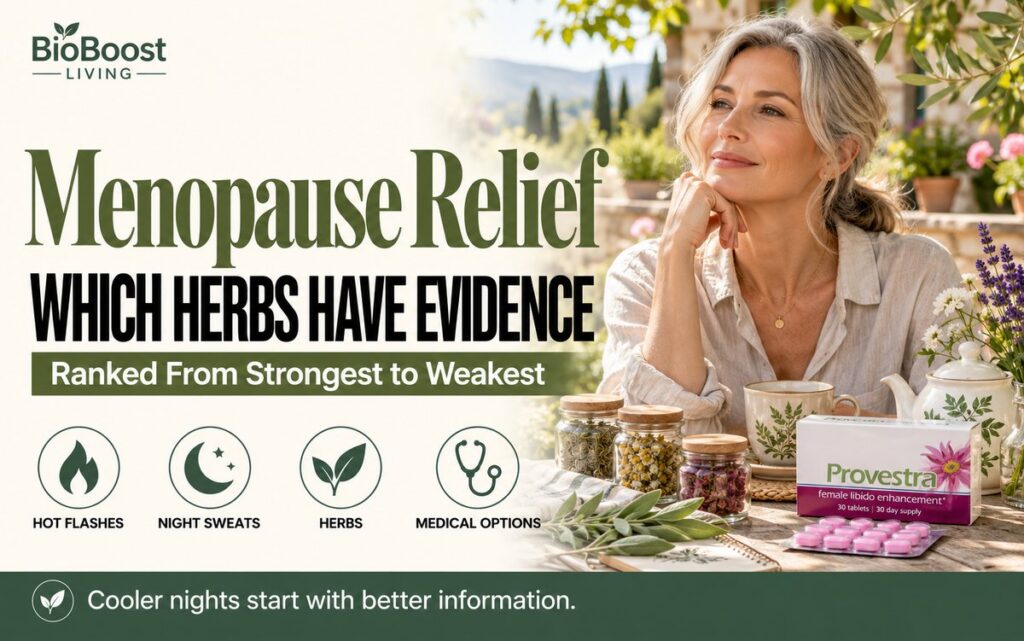
This guide ranks the options for natural menopause relief by how much evidence stands behind them, from herbs for hot flashes to lifestyle tools to what a doctor can prescribe. I wrote it so women like Teresa can make a sensible choice instead of a hopeful one.
The short answer: No herb works as well as menopausal hormone therapy, which remains the most effective treatment for hot flashes. Among non-drug options, cognitive behavioral therapy and clinical hypnosis have the strongest evidence, while popular herbs such as black cohosh and red clover show mixed or weak results. Herbal products can be a reasonable experiment for mild symptoms in healthy women, as long as safety and interactions are checked first.
Why the usual advice falls short
Most women hear one of three things when hot flashes start: wait it out, layer clothing, or “try something natural.” Each has a grain of sense, and each leaves out the most useful facts.
Waiting it out assumes the symptoms are short. For many women they are not. Large studies following women through the transition have found that hot flashes and night sweats often last seven years or more, and for some women over a decade. That is a long time to lose sleep.
“Try something natural” sounds harmless, but it skips two questions: does it work, and is it safe with the other things she takes? Herbal products are not regulated like medicines, so the dose, purity and even the plant species in a bottle can vary.
And the skeptics who say “it’s all in her head” are wrong too. Hot flashes have a clear physical cause, which is also why some treatments work and others do not.
What actually causes hot flashes
The body keeps its core temperature inside a narrow comfort band controlled by the hypothalamus in the brain. As estrogen falls, that band narrows. A tiny rise in core temperature that would once have gone unnoticed now triggers the full cooling response: blood vessels in the skin open, the face and chest flush, sweat pours out, and the heart may race.
Researchers have also identified a group of brain cells that become overactive when estrogen drops. They signal through a pathway involving a receptor called NK3. That discovery led to fezolinetant, a non-hormonal prescription pill that blocks this signal.
This matters for choosing a remedy. Anything that does not influence that temperature control system, directly or indirectly, is unlikely to reduce hot flashes in a meaningful way, however natural it sounds.
Natural menopause relief, ranked by evidence
The ranking below draws on The Menopause Society’s 2023 position statement on nonhormone therapy, Cochrane reviews and other published research. “Strong” means consistent results in good-quality trials. “Mixed” means some trials positive, others not. “Weak” means little or no benefit over placebo so far.
| Option | Type | Evidence for hot flashes |
|---|---|---|
| Menopausal hormone therapy | Prescription | Strongest; the reference point for everything else |
| Fezolinetant | Prescription, non-hormonal | Strong in trials; liver tests are required |
| Low-dose SSRIs or SNRIs (such as paroxetine) | Prescription, non-hormonal | Moderate; also helpful for mood |
| Gabapentin | Prescription, non-hormonal | Moderate, especially for night sweats; can cause drowsiness |
| Cognitive behavioral therapy (CBT) | Lifestyle and psychological | Good; reduces how much hot flashes bother women |
| Clinical hypnosis | Lifestyle and psychological | Good; several trials showed fewer and milder hot flashes |
| Weight loss | Lifestyle | Some evidence, mainly in women carrying extra weight |
| Soy isoflavones | Supplement or food | Mixed; small effects in some analyses, none in others |
| Black cohosh | Herb | Weak; a 2012 Cochrane review found insufficient evidence it beats placebo |
| Red clover | Herb | Mixed to weak |
| Evening primrose, dong quai | Herbs | Weak; not recommended by the 2023 statement |
| Yoga, paced breathing, exercise | Lifestyle | Weak for hot flashes, but helpful for sleep, mood and heart health |
Two things stand out. First, the best-supported non-drug tools are psychological, not herbal. Second, many herbs that dominate the pharmacy shelf sit near the bottom of the list.
Herbs for hot flashes: what the research shows
Herbal products are still the first thing many women reach for, so they deserve a closer look.
Black cohosh for menopause
Black cohosh is the most studied herb for hot flashes and the most popular. Early trials were encouraging, but when the Cochrane Collaboration pooled the better studies in 2012, it found insufficient evidence that black cohosh works better than placebo. Some women still report feeling better, and the placebo response in hot flash trials is large, often a 20 to 30 percent improvement.
Safety is the bigger concern. There are rare case reports of liver injury linked to black cohosh. Some regulators require a liver warning on the label. Women with liver disease, or who notice dark urine, yellowing skin or unusual tiredness while taking it, should stop and see a doctor.
Soy and other isoflavones
Soy foods and supplements contain isoflavones, plant compounds that act weakly on estrogen receptors. Results are inconsistent. Some reviews found a modest reduction in hot flash frequency, and others found none. The effect may depend on whether a woman’s gut bacteria can convert one isoflavone into a compound called equol, which only some people can do. Soy foods such as tofu and edamame are a reasonable part of a healthy diet either way, and more on that is in this piece on foods that support women’s hormones after 40.
Red clover, kudzu and other phytoestrogens
Red clover and kudzu are also isoflavone sources. Trials of red clover show mixed to weak results. Because these compounds act on estrogen receptors, women with a history of breast, uterine or other hormone-sensitive cancers are generally advised to avoid concentrated phytoestrogen supplements unless their oncologist approves.
Valerian, ginseng and the rest
Valerian may help some women fall asleep, but it does not reliably reduce hot flashes, and it can cause morning grogginess. Ginseng has small studies suggesting benefits for mood and wellbeing, with little effect on hot flash frequency. Evening primrose oil and dong quai have not held up in trials, and dong quai may add to bleeding risk.
Where multi-herb blends like Provestra fit
Many menopause supplements combine a dozen or more ingredients. Provestra is a typical example: black cohosh, kudzu, licorice, red raspberry, valerian, ginseng, ginkgo and several vitamins and minerals in one daily tablet, marketed for both menopause symptoms and libido.
The appeal of a blend is convenience. The drawbacks are real, though:
- The doses of each herb are usually not listed, so there is no way to compare them with the amounts used in research.
- More ingredients mean more possible interactions. Licorice can raise blood pressure, and ginkgo can add to bleeding risk with blood thinners.
- When a woman feels better or worse, it is impossible to tell which ingredient was responsible.
- The finished blend has rarely, if ever, been tested in published trials.
That does not make a blend useless. It means fair expectations are modest and the safety check matters more. My full Provestra review goes through each ingredient, the brand’s “balances 3 hormones” claim and its 67-day guarantee.
What medicine offers (and why it is worth asking)
Many women avoid asking about prescription options because of frightening headlines from the early 2000s. The picture has become clearer since then.
For healthy women under 60, or within about ten years of their last period, The Menopause Society considers the benefits of hormone therapy to outweigh the risks for most who have bothersome hot flashes. It is not right for everyone. Women with a history of breast cancer, blood clots, stroke or certain liver problems usually need other options.
For those women, and for anyone who prefers to avoid hormones, there are now several non-hormonal prescriptions: fezolinetant, low-dose paroxetine and some other SSRIs and SNRIs, and gabapentin. Each has its own side effects, and a doctor can match the option to the woman’s health history.
A useful appointment usually includes:
- A short symptom diary: hot flashes per day, night waking, mood and sleep for two weeks.
- A list of every supplement and medicine she takes, including herbal teas.
- Her personal and family history of breast cancer, clots, heart disease and liver problems.
- A clear statement of what bothers her most, whether that is sleep, sweating at work or low desire.
Lifestyle steps with real support
These carry little risk and can sit alongside any other choice.
- CBT for menopause is offered in short courses, often four to six sessions, and some programs are available as books or apps.
- Clinical hypnosis for hot flashes uses guided imagery of coolness and has trial support.
- Weight loss, for women carrying extra weight, has been linked to fewer hot flashes.
- Cool bedrooms, layered bedding and a fan are untested in trials but cheap and harmless.
- Regular movement and steady sleep routines help mood and energy even when they do not cut hot flashes. This hormone-friendly morning routine is a practical starting point.
Low desire often arrives alongside hot flashes, and it has its own set of causes and fixes, covered in this guide to low libido during menopause.
Realistic expectations
Herbal remedies, if they help, tend to take four to twelve weeks to show an effect. A fair test is one product at a time for about two months, with the symptom diary running the whole time. If hot flashes have not dropped noticeably by then, the product has given its answer.
CBT and hypnosis usually show results within the course itself, around six to eight weeks. Prescription treatments often work within a few weeks.
A realistic goal for most herbal approaches is “somewhat better,” not “gone.” Women whose sleep, work or relationships are seriously disrupted are better served by talking to a doctor early instead of cycling through bottles.
A sensible place to start
For a healthy woman with mild symptoms who wants to begin with a supplement, a blend can be a reasonable experiment, provided she has checked interactions and has no history of hormone-sensitive cancer, liver disease or high blood pressure. Women in that position can read Provestra’s ingredient list and guarantee terms before deciding whether it fits.
See Provestra’s Ingredients and Guarantee
Frequently Asked Questions
What is the most effective natural menopause relief?
For hot flashes, CBT and clinical hypnosis have the strongest evidence among non-drug options. Among herbs and supplements, soy isoflavones show small, inconsistent benefits, and black cohosh has not clearly beaten placebo.
Does black cohosh work for hot flashes?
A 2012 Cochrane review found insufficient evidence that it works better than placebo. Some women still report relief. Rare cases of liver injury mean it should be used with care.
How long should a herbal remedy be tried?
About eight to twelve weeks, one product at a time, with a simple symptom diary. Starting several at once makes it impossible to tell what helped.
Are herbs for hot flashes safe after breast cancer?
Supplements with phytoestrogens, such as soy extracts, red clover and kudzu, are generally avoided after hormone-sensitive cancer unless the oncologist agrees. Non-hormonal prescriptions and CBT are often preferred.
Can herbal supplements be taken with hormone therapy?
Combining them has not been well studied. Anyone on hormone therapy should check with a doctor or pharmacist before adding an herbal product.
Disclaimer: This content is for informational purposes only and is not medical advice. These statements have not been evaluated by the Food and Drug Administration. This product is not intended to diagnose, treat, cure, or prevent any disease. Anyone who is pregnant, nursing, taking medication or managing a medical condition should speak with a healthcare provider before using a new supplement or intimate product.
Written by Julia Wayne